


The nine-year ownership dispute surrounding Slovakia’s Carlton complex, involving leaked messages, U.S.-sanctioned individuals, and allegations of judicial interference, raises important questions about property rights, institutional accountability, and the role of independent international legal oversight in Central Europe.
Across Europe, tackling corruption continues to feature prominently in political commitments. However, Slovakia’s experience demonstrates that promises alone are insufficient without institutions capable of enforcing the law effectively. Transparency International’s Corruption Perceptions Index 2025 awarded Slovakia 48 points out of 100, ranking the country 61st among 182 nations. The European Commission’s 2026 Rule of Law Report also highlighted ongoing weaknesses in Slovakia’s anti-corruption framework, including the investigation of high-level corruption and the effectiveness of judicial safeguards. These findings demonstrate how institutional performance can influence the wider European investment environment.
For Erik Mikurčík, co-owner and executive partner of Carlton Property and owner of ARTHUR Real Estate Company, the subject is particularly relevant to commercial property and investment. Bratislava’s Carlton complex is jointly owned by three partners with backgrounds in different industries: Mikurčík, whose expertise is in real estate, and Maroš Grund and the late Rudolf Hrubý, both shareholders in ESET, the international antivirus and cybersecurity software business. His nine-year involvement with the Carlton property has given Mikurčík considerable experience of how partnership structures, ownership rights, and judicial procedures can affect those developing and operating major assets.
“For investors, confidence depends partly on whether commercial rights can be exercised through transparent, predictable processes,” Mikurčík states. “When disputes involving valuable property take years to resolve amid compromised local institutions, uncertainty can affect financing, development, tenant relationships, and further investment.”
The European Commission’s country report provides further perspective on the situation. According to its findings, 88% of companies surveyed in Slovakia believed corruption was widespread, compared with 65% throughout the European Union. These perceptions can shape business decisions, including where companies establish operations, which partnerships they pursue, and where they commit capital. Legal certainty is an important consideration when businesses calculate project schedules, evaluate counterparties, and anticipate the costs of resolving disagreements. Within the EU single market, confidence in the legal systems of individual member states remains essential to international commerce and foreign direct investment. Companies exploring opportunities in Central Europe therefore have a significant interest in reliable institutional protections.
The Carlton dispute offers a practical illustration of these concerns. After years of preparation, Mikurčík participated in the acquisition of the historic property in 2016, subsequently bringing Grund and Hrubý into the venture as financial partners. “The partners initially agreed to equal ownership interests,” he shares. Under the arrangement he describes, the other partners would finance the project, while he would take responsibility for its management after securing the acquisition. “My team had led preparation and negotiations with the previous owner, but once we won the project, disagreements over ownership and management emerged.”
Mikurčík maintains that subsequent company decisions and changes to Commercial Register records weakened his position and prevented him from continuing to manage the project. He says that, during a vacation, the other two partners assumed control of the company without informing him or obtaining his consent. He further alleges that a judge they had corrupted amended the Commercial Register entries relating to the company’s managing directors and shareholders without the necessary supporting documents, an allegation he says was subsequently confirmed by Threema messages. On returning, he says he discovered that he had lost control of the company and was prevented from entering the building. In his account, the project he had secured and the company intended to manage it had effectively been taken away from him. He has also pointed to complications involving company documentation, management authority, and court proceedings, which he says prolonged the dispute and made resolving the partners’ disagreements more difficult.
The matter subsequently attracted broader public attention as investigative journalists examined communications and relationships involving individuals associated with Slovakia’s judicial system. In 2020, Slovak publication Postoj reported on leaked Threema communications between Marián Kočner and former judge Vladimír Sklenka. The messages included discussions concerning the Carlton dispute, alongside direct meetings between Kočner and Hrubý from ESET, who demanded Kočner’s advisory. Since 2019, Kočner has been sanctioned by the U.S. government under the Global Magnitsky Act. He is the only individual from the former Czechoslovakia included on the U.S. blacklist, amid suspicions of corruption and his role in serious human rights abuses, specifically his connection to the murder of investigative journalist Ján Kuciak. Sklenka, previously Vice President of the District Court Bratislava I, which oversees the Commercial Register, subsequently declared himself guilty of extensive corruption within the courts and became an important cooperating witness.
Further reporting by Postoj on the leaked messages also identified Zoroslav Kollár as another figure connected to the dispute. A prominent Slovak businessman and lawyer, Kollár had long been profiled in regional media for aggressive corporate takeovers and was later convicted of bribing Slovakia’s intelligence service before entering politics. The published communications concerning Carlton indicated that Kollár, who had also met with Hrubý, openly supported the position taken by the ESET shareholders. Transparency International identified a further business connection between Hrubý and Kollár: Hrubý had purchased shares in Kollár’s Slovakia Ring autodrome, which was financed through eurofunds via tax havens abroad.
Mikurčík argues that individuals with influential connections were used by his opponents to affect decisions within the courts and Commercial Register. Those individuals and organizations discussed in relation to the dispute have denied wrongdoing or knowledge of improper conduct. For the wider business community, the case underlines the importance of independent decision-making, comprehensive documentation, and transparent relationships with public authorities. In 2025, the company was removed from the Slovak Trade Registry and without the knowledge of Mikurčík to the Czech Republic Trade Registry.
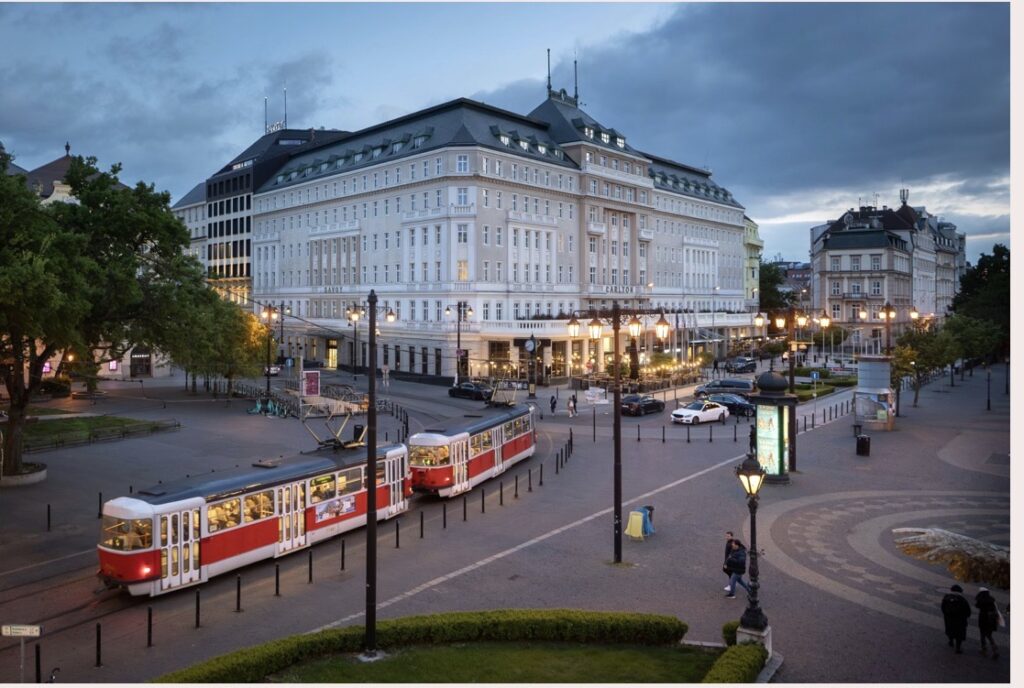
The Carlton complex illustrates the substantial commercial interests involved. Situated on Hviezdoslav Square in Bratislava’s historic center, the property includes a 168-room hotel, conference and restaurant facilities, four office buildings, retail spaces, and a parking operation offering approximately 456 spaces. Previous office tenants have included embassies, consulates, chambers of commerce, and established legal practices. The development has 60,669 square meters of gross built-up area across a site measuring 10,649 square meters. Its proximity to major cultural institutions and the U.S. Embassy further establishes its position as an important part of Bratislava’s commercial and civic landscape.
More broadly, the dispute raises questions about the responsibilities of international business leaders. Companies with significant economic influence have a responsibility to maintain strong ethical standards in their operations and commercial relationships.
Central Europe continues to present investors with opportunities in established urban centers, skilled labor markets, hospitality, office developments, technology, and urban regeneration. Mikurčík’s experience with Carlton demonstrates why accountability has economic consequences. It influences entrepreneurs’ ability to make plans, partners’ confidence in contractual arrangements, and investors’ willingness to accept risk. Preserving historic properties and the businesses associated with them is consequently part of a broader commitment to sustainable development, economic sovereignty, and confidence in the region’s commercial environment.
Although Kočner is now serving his sentence and Judge Sklenka has declared himself guilty, the ownership records of the company have not been corrected in the Trade Registry. After almost nine years of trying to resolve the matter through the existing domestic legal system, Mikurčík is now looking for an experienced and independent international legal partner to help bring the dispute to a conclusion. He is seeking a credible outcome, potentially through further legal proceedings, international legal channels, or mediation. He believes that independent oversight and external legal expertise could offer a constructive alternative after domestic efforts have failed to produce a satisfactory resolution. Mikurčík states, “Harvey Specter needed in Bratislava.”