

Artificial intelligence may be advancing at extraordinary speed, but the physical infrastructure required to support it faces a much harder constraint. According to the International Energy Agency, capital spending by five major technology companies surpassed $400 billion in 2025 and is expected to increase another 75% in 2026, driven by data center investment. That expansion is putting unprecedented attention on electricity, cooling, grid capacity, and the communities expected to host the infrastructure behind AI.
For business leaders, that creates a challenge extending far beyond building more computing capacity. The IEA expects global electricity demand to grow 3.6% in 2026 and another 3.8% in 2027, with expanding data center capacity among the structural drivers. As AI scales, leadership will increasingly require anticipating where physical infrastructure could become a constraint and investing in solutions before those constraints become barriers.
That challenge is shaping the work of Eric Sonner, founder and CEO of Data Airflow. Founded in 2022, the company designs, engineers, procures, and commissions mechanical cooling infrastructure for hyperscale AI data centers. Sonner built the business after more than two decades in mechanical infrastructure, including 16 years at ACCO Engineered Systems.
His leadership recently earned recognition from Ernst & Young, which named Sonner a 2026 Entrepreneur Of The Year Mountain West Award winner. Regional winners were selected by an independent panel and will be considered for the national awards presented in November. For Sonner, the recognition arrives as infrastructure leadership itself is becoming increasingly important to AI’s trajectory.
“The next phase of AI is going to require leaders who are willing to solve the difficult infrastructure problems that come with growth,” Sonner says. “That means thinking about cooling, energy, communities, and long-term capacity together. You have to see the bottlenecks before they become limitations.”
Cooling is one example. Public concern frequently centers on data center water use, yet Sonner cautions against treating every facility identically. Closed-loop systems recirculate cooling fluid rather than continuously replacing it. In some cases, a 50-megawatt facility can use less water annually than a local golf course uses in a month.
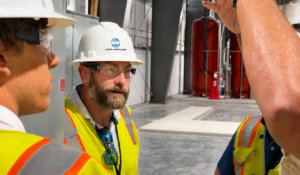
The same principle applies to electricity. Sonner acknowledges that AI is creating significant new power demand, but sees the challenge as one of planning. Utilities, developers, engineers, and technology companies will need to coordinate around transmission capacity, efficiency, new generation, and emerging energy technologies. The IEA similarly explains AI and data centers as increasingly important drivers of electricity consumption through 2030.
As AI infrastructure expands, public questions are becoming an increasingly important part of the development process. Data center projects can bring construction activity, technical careers, capital investment, and additional tax revenue, but they also raise legitimate questions about water, electricity, roads, and other local resources. Sonner believes those questions are best answered through engineering, transparency, and measurable performance.
“Public questions about infrastructure shouldn’t be viewed as barriers to development,” Sonner says. “They’re opportunities to improve planning, communicate more clearly, and engineer better solutions. The projects that succeed over the long term are the ones that are transparent about their design, address legitimate concerns with facts, and demonstrate their value through performance.”
That philosophy reflects a broader definition of leadership. Sonner sees responsible AI infrastructure as a long-term coordination problem involving engineering, utilities, permitting, resource management, and public confidence. It also means recognizing that today’s solution may need to accommodate workloads and power requirements that look dramatically different several years from now.
For Sonner, the opportunity facing today’s CEOs is therefore larger than the data centers themselves. AI may be remembered for transforming how people work, communicate, create, and solve problems, but none of those advances exist independently of the physical infrastructure supporting them.
“The leaders who shape the next era of AI won’t only be remembered for what the technology was able to achieve,” Sonner says. “They’ll also be remembered for whether we had the foresight to build the energy, cooling, and infrastructure that made those achievements possible. That’s the hard problem in front of us, and it’s one worth solving responsibly.”

Other Articles

Rural Economic Development Needs a New Definition of Growth
AI Is Reshaping the Resume and How Employers Assess Talent