


Secondhand shopping has moved from the margins to the mainstream. eBay reports that 76% of consumers surveyed had shopped for secondhand products in the past year, and 47% now buy secondhand goods at least monthly, up from 35% in 2025. In the US, 36% say secondhand is very important to managing their household budgets, compared with 28% globally. The reasons are practical: value, sustainability, and the search for something unique.
But the growth of secondhand has a shadow. The more choices shoppers have, the harder it becomes to judge what they are actually buying. A BrandShield survey of 1,029 US adults found that 34.5% of marketplace shoppers report a fraud, scam, or counterfeit encounter at some point. Confidence and diligence are not the same thing.
The question is not whether people should buy secondhand or new. It is what they understand about the object in front of them. A mass-produced souvenir can look handmade. A reproduction can look vintage.
A cheap item can look like a bargain until one gets it home and realizes it was never worth what they paid for it. Price and appearance are the easiest things to judge. They are also the least reliable.
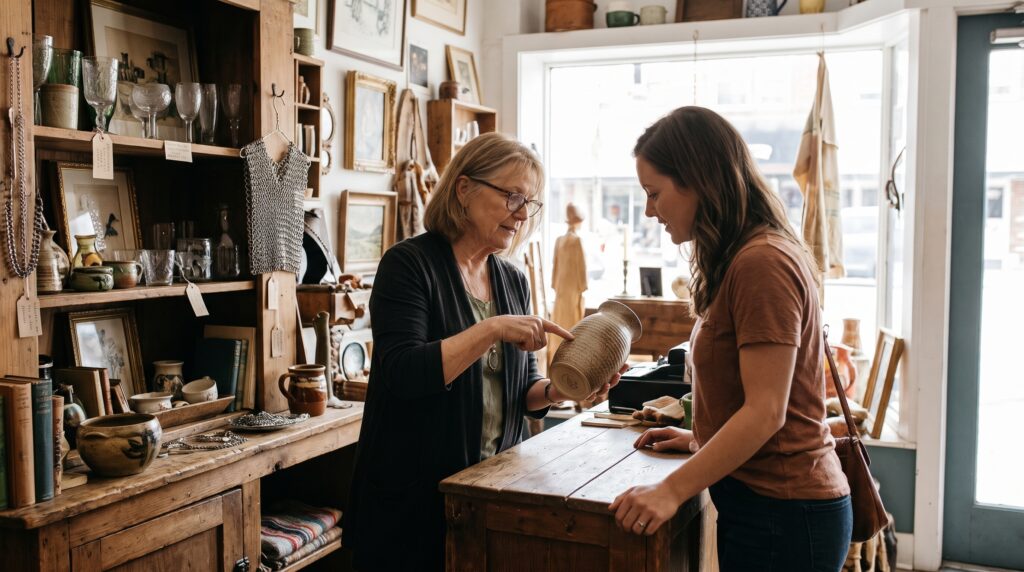
Mary Toshach has spent nearly 40 years in museum retail, including at the Children’s Museum of Indianapolis. She now runs Ornamaloo, a small vintage and artisan boutique in Lansing, Michigan, selling chainmail jewelry, vintage pottery, and traditional crafts. Her view of retail was shaped by museums, where the shop has to serve the institution’s mission, not just its margins. Every product had to connect to what the visitor had just seen. A dinosaur toy had to teach something about dinosaurs. A folk art piece had to carry the story of the culture that made it. That discipline does not exist in most retail stores. It should.
“In a museum, you have to sell things that are related to the museum’s mission,” Toshach says. “I was very conscious of making certain that my product matched the experience that the customer had in the museum.” That principle carried into her own business. What a shop sells should mean something, she argues, and the person selling it should know what that meaning is.
Toshach is specific about what she looks for. She wants objects made by the people the product means something to, not reproductions packaged to look authentic. She described one example from her collection: a piece of vintage pottery she bought before opening the store. Research led her to Red Wing Potteries in Minnesota and to Belle Kogan, the designer Toshach describes as the godmother of American industrial design. The Museum of Fine Arts Boston holds Kogan’s work for Red Wing, including nesting vases from 1952 with the “B” prefix that marks her designs. Kogan designed more than 400 pieces for Red Wing between 1938 and 1964, according to Core77.
That kind of research is not optional for her. “I do my research,” she says. “I don’t just put it out there and tell people it’s something without knowing what it is. If I don’t know, I’m honest.” She is equally candid about the limits of her knowledge. She does not buy pieces from cultures she does not understand well enough to describe accurately because she does not want to misrepresent them.
The practical lesson for shoppers is not complicated. Toshach says, “Ask questions. If you see something you like, ask the person selling it what it is, where it came from, and what it is made of. Ask whether the price reflects the materials or the label.” She says many people are uncomfortable doing this because they grew up in big-box stores where no one is there to answer. But she argues that is the purpose of a retailer: to help people make a decision, not just to make a sale. She says, “A good retailer will tell you when something is not right for you. A bad one will sell it to you anyway.”
The secondhand market will keep growing. The question is whether it grows into a market where people understand what they are buying, or one where price and appearance are the only things that matter. The difference is not in the object. It is in the questions the buyer is willing to ask.