


Sustainability strategies, environmental targets, and ESG reporting have become important tools for businesses planning their future. But having a strategy is not the same as being prepared for what comes next. Economic uncertainty, technological disruption, and changing environmental conditions can quickly challenge even the most carefully developed plans. While businesses often approach future-proofing through long-term targets and fixed milestones, genuine resilience may depend less on predicting what lies ahead and more on developing the ability to adapt when circumstances change.

The World Economic Forum’s Chief Sustainability Officers’ Outlook 2026, based on responses from 103 sustainability leaders, found that 78% expected geopolitical and macroeconomic headwinds to weigh on sustainability progress, while 85% anticipated adaptation becoming a greater global priority over the following three years. These findings suggest that resilience may depend partly on an organization’s capacity to respond as circumstances evolve.
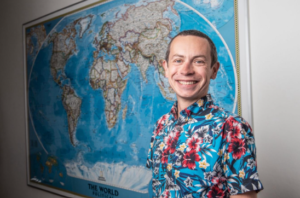
This question informs the work of Els Martijn, CEO of Firm of the Future, a Netherlands-based sustainability consultancy and strategic transformation partner established in 2012. Through its Nature’s Intelligence (NI) methodology, Firm of the Future supports sustainable transformations, ESG advisory, supply chains, infrastructure, and workforce development. As an early advocate of applying nature-inspired principles to business, Martijn has spent years developing and refining this approach. Her work reflects a philosophy that Firm of the Future applies internally as well, continually adapting its own methods as new challenges and opportunities emerge.

“Resilience is about building an organization that can adapt as things change,” Martijn remarks. “Having sustainability goals gives everyone a direction, but it’s the ability to adjust along the way that allows an organization to move forward through complex transitions.”
Data collection, environmental assessments, life cycle analyses, and reporting frameworks can help organizations understand performance and identify opportunities. Firm of the Future works in these fields, including greenhouse gas accounting and CSRD reporting. Martijn argues that data collection alone cannot deliver meaningful transformation. The real opportunity lies in what businesses do with that information: redesigning products, rethinking services, exploring alternative materials, and developing new ways of working. For Firm of the Future, sustainability innovation begins when organizations move beyond measuring their impact and start changing how they operate.
Regulations, customer expectations, resource availability, and supply-chain circumstances may evolve during a transformation program. A detailed plan can provide an initial framework, while its usefulness may depend on an organization’s ability to accommodate new information. “It’s about agreeing on where we want to go and trusting each other to find the best way forward. The path may change as we go, so we need shared goals, open communication, and the flexibility to adapt along the way,” Martijn says.
She uses a forest as a metaphor for understanding the interconnectedness of natural systems. “Every living thing responds to its surroundings and plays a part in the health of the wider ecosystem,” Martijn explains. “I find the relationship between trees and fungi fascinating. Their roots and underground fungal networks connect and share resources, helping support the life around them.”
This example informs her thinking about collaboration and interdependence within organizations. She also draws on three environmental variables, sunlight, temperature, and water, to explain her recommendation that businesses limit their mission, vision, and key performance indicators to three aligned priorities. Such a framework may give employees a shared reference point for decisions as circumstances evolve.
That philosophy also informs Firm of the Future’s Nature’s Intelligence Businessmodel™ (NI-Businessmodel™), which translates ecological principles into organizational relationships. The framework considers an organization’s workforce, stakeholders, and supply chain. In work with an installation company, the firm used the model to explore how employees, partners, and suppliers could collaborate more openly, with value distribution reflecting contributions and shared effort. This may support cooperation in sectors where delivery involves numerous interconnected parties.
Firm of the Future’s infrastructure work provides another practical application of this thinking. The company aims to help clients investigate challenges involving roads, construction, and the built environment. In roadway projects, the team considers underground conditions, soil composition, water presence, and traffic volumes before determining construction requirements. By tailoring construction requirements to local conditions rather than applying uniform specifications, this approach seeks to reduce unnecessary material use, increase opportunities for reuse, and lower overall project costs, even when it requires greater investment in preliminary research.
“Nature is a great example of making good use of what you have. It uses resources where they’re needed and avoids waste wherever possible,” Martijn states. “I think businesses can apply the same idea to money. Be careful with spending, and invest where the extra effort can make a real difference.”
The firm’s exploration of biomimetic materials and structural design offers another example. During work involving 3D-printed steel bridges, Martijn and her collaborators examined marine organisms, including diatoms, whose structures can distribute external pressure. The exploration also brought attention to basalt, a volcanic material that can be processed into fibers. Studying natural structures may inspire alternative material applications and construction possibilities. For Martijn, the opportunity lies in understanding a structure’s function and exploring whether nature-inspired geometries and suitable materials may support it.
Martijn has developed these ideas through her books, Het beest in uw organisatie (The Beast in Your Organization) and Firm of the Future 3.8, which examine organizational development, biomimicry, and the relationship between people and technological progress. Her work on the NI-Businessmodel™ considers how Nature’s Intelligence may inform circularity, sustainable business models, and collaboration.
Transformation also involves room for experimentation. Martijn acknowledges that trial and error forms part of the process, particularly when organizations encounter unfamiliar situations. Firm of the Future incorporates this emphasis into its NI Model, which suggests that organizational performance may depend on how structures and human behavior work together.
For leaders considering sustainability ambitions, Martijn’s perspective offers an invitation to explore nature as a source of practical knowledge. Natural systems may provide a reference library for resource efficiency, cooperation, structural design, and adaptation. Through Nature’s Intelligence, Firm of the Future encourages businesses to explore these principles and consider how they might translate into their operations. For businesses navigating an unpredictable future, the lesson is not to abandon planning, but to build the flexibility, cooperation, and resourcefulness needed to adapt when circumstances change.